Inari probably thought dysphoria was a long way behind them. I wanna give them a platonic hug, one enbie to another.
MysticWav
September 14th, 2026 8:05 AM
I really like how you’ve been handling Inari’s… well I’m not sure what category Inari considers themselves to be in. I want to say fluidity, but it could also be non-binary or plurality. Both now and back on the ship.
Imagining the way a powerful magical entity would feel small from magic disruption too.
Fluidity is probably a good word for it. For a powerful shapeshifter, most physical features that humans consider so important to their identity, such as gender or coloration, would be about as important as we consider clothing, and just as easily changed.
Conversely, for a being whose self-identity is at least partially built around their ability to change their form at will, suddenly finding themself locked into a single static body would be… an experience, and probably not one they would look back on fondly.
I would have agreed with Fluidity primarily because Inari changes not only their Gender, but also their Age regularly. Fluidity is the best word if at least one of the options can be changed freely in every possible manner. Particularly since we reader’s don’t actually know how much Inari regularly changes about themselves.
Unmentioned possible points of change include Build, how Androgynous they are, cultural race and more, though I suspect that Inari has made decisions for most of those. Height, for example, could easily be “Current Standard for my Gender”, because nutrition has improved significantly lately, and Humans the world over have gotten taller. To the point where Yuki would have been fairly close to standard height, or only just slightly short. Even if her being as Stacked as she is would have been even more insane, historically speaking.
NLGS
September 14th, 2026 8:09 AM
Pouty foxkit. 😁
Ian
September 14th, 2026 9:30 AM
Kate is stuck with the most awkward babysitting situation ever.
Inari going from being completely in control of their form and being able to teleport where they please to a locked child body without the power/ability to do anything they were used to but all the knowledge to do it has to be an odd combination of frustration, anger, and raw fear because this is probably the closest to dying they have ever come and that fear probably overwhelms the other feelings but they don’t want to admit it and thus mask with the other feelings. I may be reading a bit too much into this but it could make for an interesting bonding moment for Kate and Inari if she gets them to open up about it. Kind of an interesting counterpoint to Phil/Yuki. Who knows maybe the next cut to the kids will have them talking about a visit from their aunt and cousin.
uhl
September 14th, 2026 10:08 AM
Pouty foxkit os cute foxkit…
Belvarius
September 14th, 2026 12:06 PM
I get Inari being down due to their situation. Hopefully Kate will figure something out quick to help lift them back up.
Montana
September 14th, 2026 12:43 PM
moody teen
Andi Raccoon
September 14th, 2026 1:08 PM
I’m wondering, could Inari recharge from some of Kates Orichalcum jewelley?
Torbjörn Larsson
September 15th, 2026 12:42 AM
At least Inari got their childish pout down pat.
The Ninjaneer
September 15th, 2026 6:13 PM
Gaming time! 😀
Denis Zubko
September 16th, 2026 3:01 AM
Good day. I, one again, come here to clarify some things I find difficult to grasp or understand.
Context – I come from a country and culture where there is no “them”. It is either he or she. Just for the context. No judgement. I am here to understand the implied meaning of a comic, not bang rocks.
Here and previously in the comic, Inari’s gender is a non factor – because it does not matter for the context of the story. He, she, it, toaster, attack helicopter, whatever.
Is a comment by Sage under the comic, using “they” is it there to use some gender-neutral clasification, or does that mean to adress the multiple looks in one person? Not split personality, just one person having multiple identities, because it is a shapeshifter?
“They”, in English, is typically used as an equivalent of He/She or Him/Her for those who consider themselves to be non-Gendered. There has been attempts to make up an alternative He/She & Him/Her, but the percentage of people this is potentially applicable to is so small that, to my understanding, the attempt never really had any true chance of getting any traction in the wider populace (to my outsider understanding).
As for what Inari’s Gender actually is, they’re used to changing it constantly. As in Inari is likely supposed to be this comic’s interpretation of the Kami (effectively God or Divine Spirit) of Foxes, who was popularly depicted as both male and female depending on what they were doing, or the artist’s requirements/preferences.
Mostly what Darius said here, They is what we use to mean “that person” without assigning a gender. However, they also works here normally because we have used They as a singular term for decades- even longer than that. In English, you don’t call someone an “it” because when used that way it is usually to dehumanize them. “They aren’t a person, they are an it.” That isn’t to say you can’t use the word It when referring to a person – specifically – “It is Alex.” is saying “That person is Alex.” however if you say “Alex is an it” is more like saying “Alex is not a person”.
A common usage of singular they even when you know the gender is –
“Your father called.” “What did they want?” You aren’t claiming your father has no preferred gender- though that could be the case- it’s just they is used so commonly in that statement “What did they want?” that it’s used to talk about a single person, multiple people, or even an organization even if you know their gender.
So- That said, I do find it a little unusual you would say you aren’t familiar with any of this, but also used “attack helicopter” in your message. That’s not a reference most people are aware of unless they know about gender discourse online.
I am familiar with the gender discussions online but I never payed them much mind. But here my question was more to the like of “is it a gender neutral pronounce or is it a hint at Inari being shapeshifter and as a result having multiple identities?”
You and Drake explained that it was a gender neutral pronounce, so that answers my question.
Regarding your mild confusion about why I asked at all in the first place.
In general, in my language (russian) we can not use the analogue of they or them for a non gendered person with good result because that is referred to multiples of something.
(Here lies the crux of my question, as I should point out – this is why I asked, is it a gender neutral or a multiple identities in one? Because in russian, they is multiple. What are they doing there? – Those sheep? Just grazing. Or – Them? Grabbing coffee before meeting (refering to multiple co-workers in office setting.))
In your example in my native language about the father, the follow up question is one hundred percent will be “What did he want?” Because in russian language, nouns have gendered meanings based on what it is, for example, a mechanic is a he, and river is a she. The house is a he, but the sea is an it. This context is important to frame my own understanding of the english used in your comic, because, while I am familiar with words and the language in general, I studied it in school and improved through usage in every day life, I do not live with the day to day use of that language or the implied meanings, or the slang, or the mirriad nuances the language carries for the day to day user and native speaker. A always expirience the meaning through my own lens of my native tongue and culture. As a rather direct person, I prefer to ask and to understand intended meaning, than to assume my own in the work of art (the comic).
As a DM, I often use the term “it” to describe monsters of shapeshifting nature in my language. For example, if I describe a werewolf with fixed gender, I will describe it as either he or she. But if I describe a changeling from Eberron, I describe it as an it, because it has no gender. A warforged from the same Eberron can be described as an it, because it has no assigned gender also. Several creatures with weird mishmash of parts can and should be described as it. And this it does not dehumanise in russian. It simply states the third non gender clasification of he, she, it. I can describe the same changeling as it, while it can be extremely important, integrated in a life of a party, or even be a player. But by the nature of a creature, it is an it.
I hope that clears some of the confusion. Anyway, please believe me. I am in this comment section never to argue or to pick a fight. I comment and ask questions, like the first time with Kate and the exorcist, because I am confused or unsure and want to clarify. Your work, art, language and story is yours and I have no reason, moral ground or right to impose my own vision or judgement upon it.

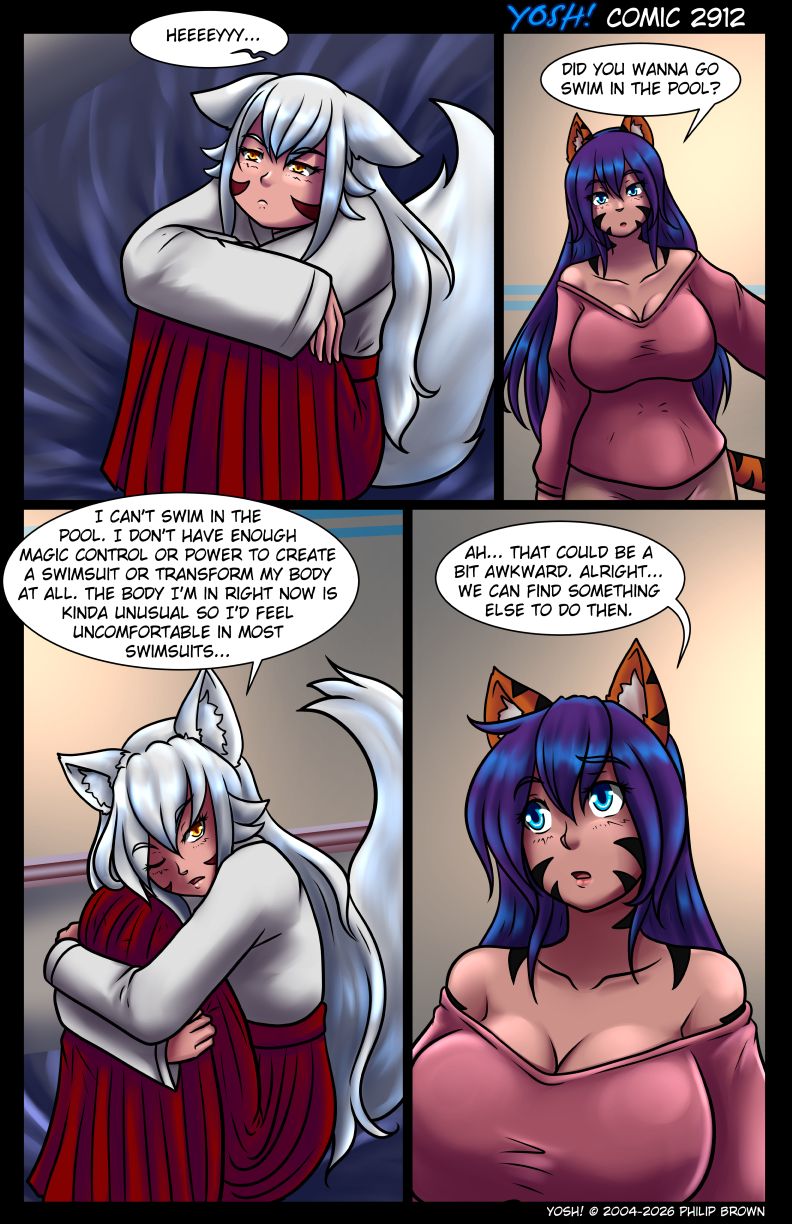
Inari, she’s probably going to be your step-mother eventually. please try to get along.
How I Met Your Step-Mother, part 1.
Inari probably thought dysphoria was a long way behind them. I wanna give them a platonic hug, one enbie to another.
I really like how you’ve been handling Inari’s… well I’m not sure what category Inari considers themselves to be in. I want to say fluidity, but it could also be non-binary or plurality. Both now and back on the ship.
Imagining the way a powerful magical entity would feel small from magic disruption too.
Fluidity is probably a good word for it. For a powerful shapeshifter, most physical features that humans consider so important to their identity, such as gender or coloration, would be about as important as we consider clothing, and just as easily changed.
Conversely, for a being whose self-identity is at least partially built around their ability to change their form at will, suddenly finding themself locked into a single static body would be… an experience, and probably not one they would look back on fondly.
I would have agreed with Fluidity primarily because Inari changes not only their Gender, but also their Age regularly. Fluidity is the best word if at least one of the options can be changed freely in every possible manner. Particularly since we reader’s don’t actually know how much Inari regularly changes about themselves.
Unmentioned possible points of change include Build, how Androgynous they are, cultural race and more, though I suspect that Inari has made decisions for most of those. Height, for example, could easily be “Current Standard for my Gender”, because nutrition has improved significantly lately, and Humans the world over have gotten taller. To the point where Yuki would have been fairly close to standard height, or only just slightly short. Even if her being as Stacked as she is would have been even more insane, historically speaking.
Pouty foxkit. 😁
Kate is stuck with the most awkward babysitting situation ever.
Inari going from being completely in control of their form and being able to teleport where they please to a locked child body without the power/ability to do anything they were used to but all the knowledge to do it has to be an odd combination of frustration, anger, and raw fear because this is probably the closest to dying they have ever come and that fear probably overwhelms the other feelings but they don’t want to admit it and thus mask with the other feelings. I may be reading a bit too much into this but it could make for an interesting bonding moment for Kate and Inari if she gets them to open up about it. Kind of an interesting counterpoint to Phil/Yuki. Who knows maybe the next cut to the kids will have them talking about a visit from their aunt and cousin.
Pouty foxkit os cute foxkit…
I get Inari being down due to their situation. Hopefully Kate will figure something out quick to help lift them back up.
moody teen
I’m wondering, could Inari recharge from some of Kates Orichalcum jewelley?
At least Inari got their childish pout down pat.
Gaming time! 😀
Good day. I, one again, come here to clarify some things I find difficult to grasp or understand.
Context – I come from a country and culture where there is no “them”. It is either he or she. Just for the context. No judgement. I am here to understand the implied meaning of a comic, not bang rocks.
Here and previously in the comic, Inari’s gender is a non factor – because it does not matter for the context of the story. He, she, it, toaster, attack helicopter, whatever.
Is a comment by Sage under the comic, using “they” is it there to use some gender-neutral clasification, or does that mean to adress the multiple looks in one person? Not split personality, just one person having multiple identities, because it is a shapeshifter?
Thanks in advance.
With best regards,
Denis Zubko
“They”, in English, is typically used as an equivalent of He/She or Him/Her for those who consider themselves to be non-Gendered. There has been attempts to make up an alternative He/She & Him/Her, but the percentage of people this is potentially applicable to is so small that, to my understanding, the attempt never really had any true chance of getting any traction in the wider populace (to my outsider understanding).
As for what Inari’s Gender actually is, they’re used to changing it constantly. As in Inari is likely supposed to be this comic’s interpretation of the Kami (effectively God or Divine Spirit) of Foxes, who was popularly depicted as both male and female depending on what they were doing, or the artist’s requirements/preferences.
Mostly what Darius said here, They is what we use to mean “that person” without assigning a gender. However, they also works here normally because we have used They as a singular term for decades- even longer than that. In English, you don’t call someone an “it” because when used that way it is usually to dehumanize them. “They aren’t a person, they are an it.” That isn’t to say you can’t use the word It when referring to a person – specifically – “It is Alex.” is saying “That person is Alex.” however if you say “Alex is an it” is more like saying “Alex is not a person”.
A common usage of singular they even when you know the gender is –
“Your father called.” “What did they want?” You aren’t claiming your father has no preferred gender- though that could be the case- it’s just they is used so commonly in that statement “What did they want?” that it’s used to talk about a single person, multiple people, or even an organization even if you know their gender.
So- That said, I do find it a little unusual you would say you aren’t familiar with any of this, but also used “attack helicopter” in your message. That’s not a reference most people are aware of unless they know about gender discourse online.
Thank you for the explanation.
I am familiar with the gender discussions online but I never payed them much mind. But here my question was more to the like of “is it a gender neutral pronounce or is it a hint at Inari being shapeshifter and as a result having multiple identities?”
You and Drake explained that it was a gender neutral pronounce, so that answers my question.
Regarding your mild confusion about why I asked at all in the first place.
In general, in my language (russian) we can not use the analogue of they or them for a non gendered person with good result because that is referred to multiples of something.
(Here lies the crux of my question, as I should point out – this is why I asked, is it a gender neutral or a multiple identities in one? Because in russian, they is multiple. What are they doing there? – Those sheep? Just grazing. Or – Them? Grabbing coffee before meeting (refering to multiple co-workers in office setting.))
In your example in my native language about the father, the follow up question is one hundred percent will be “What did he want?” Because in russian language, nouns have gendered meanings based on what it is, for example, a mechanic is a he, and river is a she. The house is a he, but the sea is an it. This context is important to frame my own understanding of the english used in your comic, because, while I am familiar with words and the language in general, I studied it in school and improved through usage in every day life, I do not live with the day to day use of that language or the implied meanings, or the slang, or the mirriad nuances the language carries for the day to day user and native speaker. A always expirience the meaning through my own lens of my native tongue and culture. As a rather direct person, I prefer to ask and to understand intended meaning, than to assume my own in the work of art (the comic).
As a DM, I often use the term “it” to describe monsters of shapeshifting nature in my language. For example, if I describe a werewolf with fixed gender, I will describe it as either he or she. But if I describe a changeling from Eberron, I describe it as an it, because it has no gender. A warforged from the same Eberron can be described as an it, because it has no assigned gender also. Several creatures with weird mishmash of parts can and should be described as it. And this it does not dehumanise in russian. It simply states the third non gender clasification of he, she, it. I can describe the same changeling as it, while it can be extremely important, integrated in a life of a party, or even be a player. But by the nature of a creature, it is an it.
I hope that clears some of the confusion. Anyway, please believe me. I am in this comment section never to argue or to pick a fight. I comment and ask questions, like the first time with Kate and the exorcist, because I am confused or unsure and want to clarify. Your work, art, language and story is yours and I have no reason, moral ground or right to impose my own vision or judgement upon it.
With best regards,
Denis Zubko
Thank you for the explanation.